
The 2027 Commercial EPC Deadline: What UK Landlords and Developers Must Do Now
If you own or manage commercial property in the UK, there is a legal deadline approaching that will determine whether your assets can be let — and whether they lose value on your balance sheet.
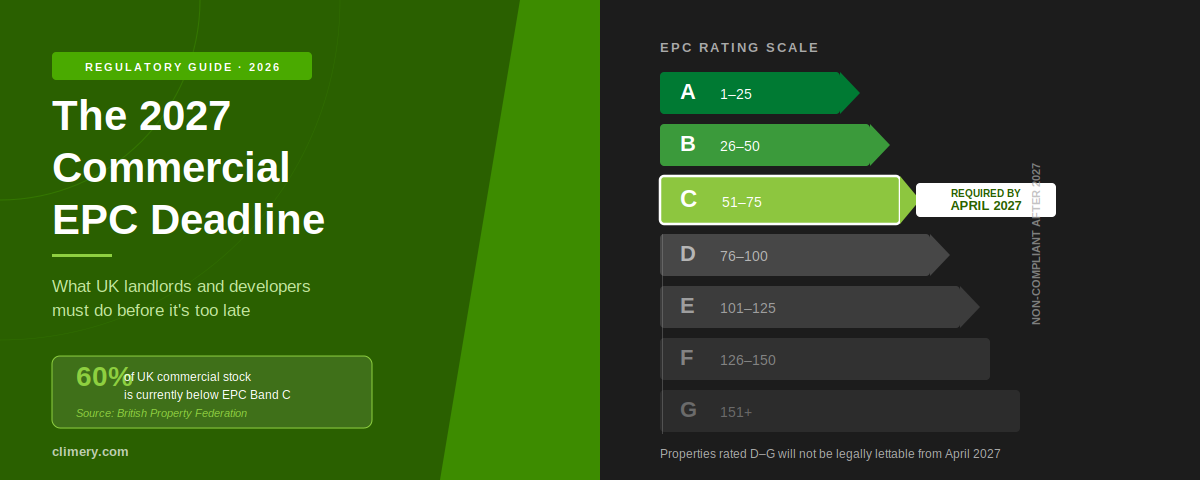
From April 2027, commercial properties must achieve EPC Band C to be legally leased to tenants. Properties that fall below this threshold will not be permitted to enter into new leases or lease renewals. From 2030, the bar rises again to EPC Band B.
Research from the British Property Federation estimates that approximately 60% of UK commercial stock currently sits at EPC Band D or below. That means the majority of commercial landlords in the UK are facing a mandatory retrofit programme and the clock is running.
The question is not whether to act. It is whether you act now, on your terms, or in 2026 under pressure, at higher cost, with less choice of contractor.
What Is MEES and Why Does It Matter?
MEES stands for the Minimum Energy Efficiency Standards, introduced under the Energy Efficiency (Private Rented Property) (England and Wales) Regulations 2015. The regulations set a floor for the energy performance of privately rented properties and have been progressively tightened since they came into force.
The timeline for commercial property is:
April 2023: EPC Band E minimum already in force for all existing commercial leases. If your property is currently let and is rated F or G, you are already non-compliant.
April 2027: EPC Band C required for all commercial properties to be legally let. New leases and lease renewals both affected.
April 2030: EPC Band B required.
The penalties for non-compliance are significant. Landlords who let a property below the minimum standard face fines of up to £150,000 per property, plus the lease itself may be challenged as invalid. Institutional tenants, banks, and investors increasingly conduct EPC due diligence — properties below the threshold are becoming unlettable in practice before the legal deadline arrives.
How Long Does an EPC Upgrade Actually Take?
This is the question most landlords underestimate.
A property that needs to move from EPC Band D to Band C is not a quick repaint. Depending on the building fabric and existing mechanical and electrical systems, an EPC upgrade programme typically involves:
Assessment phase (4–8 weeks) An energy audit and EPC assessment identifies exactly what is driving your current rating and what interventions will achieve the target band. This produces a costed options appraisal — the document you need before instructing any contractor.
Design phase (8–16 weeks) Once the improvement measures are agreed, the MEP and building fabric changes need to be designed, specified, and built into a procurement package. For anything beyond simple LED lighting upgrades, this requires mechanical and electrical engineering input.
Procurement and construction (12–24 weeks) Depending on the scope — which might include LED lighting upgrades, HVAC system replacement, insulation, controls and BMS optimisation, or window replacement — a commercial retrofit programme takes between three months and a full year on site.
New EPC assessment and lodgement (2–4 weeks) Once work is complete, a new EPC must be commissioned, assessed, and lodged on the national register before the property can be re-let.
Add these phases together and a thorough EPC upgrade programme takes nine to eighteen months from first instruction to compliant EPC in hand.
If you are starting this process in 2025, you are on schedule. If you are planning to start in 2026, you are taking a significant risk.
Working on a commercial property and need to understand where you stand on MEES compliance? Get in touch with the Climery team for a no-obligation initial conversation: hello@climery.com
What Actually Improves an EPC Rating?
EPC ratings for commercial properties are calculated using the Display Energy Certificate (DEC) or Non-Domestic EPC methodology, which assesses the building's energy intensity based on its systems, fabric, and usage. The key factors driving ratings — and therefore the key levers for improvement — are:
Heating and cooling systems Older gas boilers and inefficient air conditioning units are among the most significant contributors to poor EPC ratings. Replacing these with modern heat pumps, variable refrigerant flow (VRF) systems, or district heating connections delivers substantial rating improvements.
Lighting LED lighting upgrades with presence detection and daylight controls are typically the fastest and most cost-effective EPC improvement measure. In buildings with significant lighting loads — retail, offices, warehouses — LED retrofits can move a rating by one or two bands.
Building fabric Roof insulation, cavity wall fill, secondary glazing, and air sealing all reduce the heating and cooling energy demand that the EPC methodology penalises. Fabric improvements have longer payback periods but deliver lasting performance improvements.
Controls and BMS A modern building management system that correctly schedules heating and cooling, responds to occupancy, and prevents heating and cooling running simultaneously is one of the highest-return investments in commercial retrofit. Poorly controlled existing systems can be consuming 30–40% more energy than necessary.
Renewable energy generation Rooftop PV can offset grid electricity imports, improving the EPC rating and reducing operating costs simultaneously.
The right combination of measures depends entirely on the specific building — its age, fabric, current systems, occupancy pattern, and budget. A proper assessment, not a guess, is the starting point.
The Cost of Getting It Wrong
Beyond the regulatory fines, there are three commercial consequences of missing the 2027 deadline that landlords should quantify now:
Voids and rental loss A property that cannot be legally let generates no income. If your building requires a six-month retrofit programme that could have been completed in 2025 but is instead running in 2027 after the deadline, the void rental loss may significantly exceed the cost of earlier action.
Asset value reduction EPC ratings are now consistently factored into commercial property valuations and loan-to-value assessments by institutional lenders and investors. Sub-Band-C commercial assets are already trading at discounts in some markets, and this is expected to widen as the deadline approaches.
Contractor premium The commercial retrofit supply chain is finite. As 2027 approaches, demand for MEP engineers, energy assessors, and specialist contractors will exceed supply in many regions. Projects that can be procured now with lead time will be completed at lower cost than those procured under time pressure in 2026.
How Climery Can Help
Climery provides integrated assessment, design, and delivery support for commercial EPC compliance programmes. Our team combines MEP engineering, environmental advisory, and building performance expertise — which means we can take a property from initial assessment to compliant EPC without the fragmented supplier chain that typically slows commercial retrofit projects down.
Our typical commercial MEES engagement covers:
Initial EPC assessment and compliance gap analysis
Costed options appraisal — what measures will achieve Band C, at what cost, in what sequence
MEP engineering design for heating, ventilation, controls, and lighting upgrades
Building fabric recommendations and specification
Procurement support and contractor briefing
Construction-stage monitoring and commissioning
Post-works EPC assessment and lodgement
We work with landlords, asset managers, developers, and property companies across the UK on commercial properties ranging from single offices and retail units to multi-occupancy estates and mixed-use portfolios.
If your commercial property is currently rated D, E, F, or G, or if you are not certain of your current EPC position, the right time to get advice is now. Contact the Climery team at hello@climery.com or visit climery.com to find out how we can help.
Frequently Asked Questions
Does MEES apply to all commercial properties? Most commercial properties let under a lease are covered. There are limited exemptions — for example, properties where all cost-effective improvements have been made and the property still cannot reach the minimum standard, or buildings with very short lease terms. Exemptions must be registered on the PRS Exemptions Register and are time-limited.
What if my property already has a valid EPC showing Band C or above? EPC certificates are valid for ten years, but the underlying performance of the building is what matters. If significant changes have been made to the building's systems or fabric since the EPC was issued, or if the certificate is approaching expiry, a new assessment is advisable before the deadline.
Can I get funding for commercial EPC improvements? There are limited grant and loan programmes available for commercial retrofit in the UK, and eligibility criteria are specific. For some non-profit and public sector buildings, SALIX Finance provides interest-free loans for energy efficiency works. Climery can advise on funding options as part of the initial assessment.
What is the difference between an EPC and a Display Energy Certificate (DEC)? An EPC (Energy Performance Certificate) is required for properties being sold or let and is based on the theoretical energy performance of the building. A DEC (Display Energy Certificate) is required for public buildings over a certain size and is based on actual energy consumption. MEES compliance is assessed against the EPC, not the DEC.
How much does a commercial EPC upgrade typically cost? This varies significantly by building — a small office achieving Band C through LED and controls upgrades might cost £20,000–£50,000; a larger building requiring heating system replacement and fabric works might cost £150,000–£500,000 or more. The options appraisal Climery produces at the start of the engagement gives property owners a clear cost range before any works are committed.
Climery is a UK-based Architecture, Engineering & Construction consultancy specialising in climate-intelligent buildings. We provide integrated MEP engineering, environmental advisory, building performance, and architecture services across the full RIBA Plan of Work.
